
01
Curve
Your token opens on a bonding curve quoted in HYPE. Standard, fast, no allocation to anybody.
A launch, end to end: the curve that sells it, the market it graduates into, the vault it owns, and what a holder can actually do with any of it.
01
Your token opens on a bonding curve quoted in HYPE. Standard, fast, no allocation to anybody.
02
At 500 HYPE raised, the curve closes and everything it holds becomes the pair.
03
That pair is the token’s main market, and the protocol owns the position, which is what makes the fee capture native.
04
A vault is deployed and activated on HyperCore. From that block, every swap routes fees into a live position.
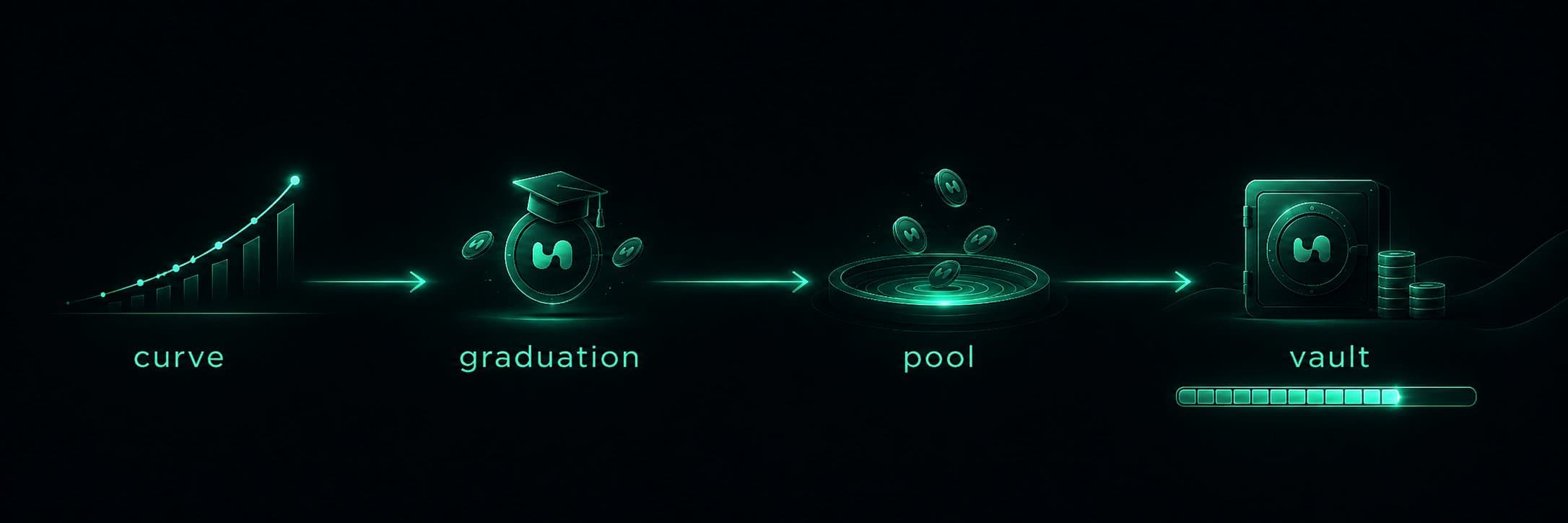
You are not launching a ticker. You are launching a ticker with a balance sheet that starts filling from the first trade, and the position belongs to the supply, pro rata, not to the deployer.
A contract deployed on HyperEVM holds an account on HyperCore at the same address. So the vault is not a manager sitting on top of a treasury. It is the account holder. It acts on its own behalf through CoreWriter and reads its own state through the precompiles. No custodian, no ops wallet, no multisig in the middle.
Which gives you the thing every treasury narrative has been missing: any holder can paste the vault address into the Hyperliquid interface and see the real position, live, without touching our front end. We are not showing you a dashboard. We are pointing you at an exchange account you can verify on the exchange.
Hyperliquid is also the only venue where the reserve can earn natively. Staking, HLP, spot books. No third party contract risk stacked on top of a community treasury.
Where the fees go
Reserve growth is a straight function of volume. Every 1M of volume puts 7,000 into the reserve, permanently. A token doing 10M a day in its first week ends that week with 490k of Hyperliquid exposure that nobody can withdraw.
The reserve, as arithmetic
ΔR = V × f × α → 0.007 × V at the default 1% fee and 70% share.
Volume processed
70M HYPE
Into the reserve, permanently
490,000 HYPE
An exit burns the share and pays it out minus a 2% haircut that stays in the vault, so every departure lifts the value of every share that stays. Buying the supply to capture the treasury just means paying everyone else their part, and leaving the haircut on the table for the privilege.
HYPE moves to the staking balance and gets delegated. Native yield, zero liquidation risk. The default.
HLP deposit. Real market making yield, real drawdown risk, stated as such.
Spot DCA, no leverage.
Off by default. If a launch opens it, the cap is frozen in the contract at deploy time and can never be raised, by anyone, including a vote.
A community owned position liquidated at three in the morning is a one tweet death for the whole protocol. That one is structural, not a parameter.
NAV per token, published continuously, read straight from the precompiles. Reserve over circulating supply, and it rises with every swap, because the reserve grows while the supply does not.
Governance sets the mandate, the fee split, the redemption windows and the directable stream, with vote weight on a time weighted balance so borrowed supply decides nothing.
With one rule that never bends: no vote can name a destination address for reserve capital. Value leaves one way only, pro rata redemption against burn.
Redemption is a queue
If the mandate is Stake, the reserve is not liquid, and that is Hyperliquid's staking model rather than our design: a one day delegation lock, then a 7 day queue back to spot, 5 pending withdrawals per account.
So 85% sits long in delegated stake and carries the yield, and 15% sits liquid as a redemption buffer. Redemptions hit the buffer first and only trigger an undelegate wave when it empties, batched, never one per user.
You burn, you get a ticket, you are served in order. The burn lands immediately while the payout is queued, so everything the reserve earns during those days accrues to the supply that stayed.
The protocol token is not exempt from its own design. The 10% cut across every launch is converted to HYPE, staked, and redistributed to locked $HSTRAT. Holders govern the mandate whitelist and the defaults applied to new launches. What they do not get is any claim on the reserves of launched tokens. That separation is absolute: the protocol earns a flow, it never holds a community's capital.
Continuity, when it is needed. Because the reserve belongs to the token and not to the deployer, an abandoned project does not lose its balance sheet. The deployer's stream is gated on a periodic proof of life. Miss the window and it pauses, accruing back into the reserve. Any address can run for takeover, holders vote, and the winner receives a stream rather than a lump sum. A takeover never touches the principal, only the flow, so whoever picks the project up has to keep volume alive to get paid.
HYPE is the unit of account across the whole system: quote asset, fee asset, default reserve asset, protocol staking asset. Every unit of volume the protocol processes mechanically increases the network's stake.
There is no Uniswap v4 on HyperEVM.
So there is no hook that can stand in front of a swap. It does not change the economics: in v3 the fee belongs to the liquidity, and the liquidity here belongs to the protocol. The market contract holds the position, so every swap accrues to it and the split happens on collection.
Nothing is deployed.
The contracts are written and tested against the live chain on a fork: a curve that graduates, a real HyperSwap pool, fees collected and split 70/20/10, a vault that reads its own HyperCore state, and a redemption that burns first and pays pro rata.
The reserve is not liquid on demand.
Under the Stake mandate it is seven days away, by Hyperliquid’s design. The buffer and the queue are how that is handled in the open rather than hidden.
Yield and Leverage carry real risk.
HLP can draw down. Leverage can liquidate, which is why it is off unless a launch opens it and why its cap can never be raised afterwards.